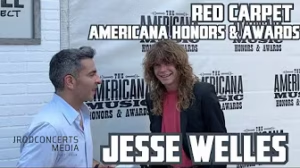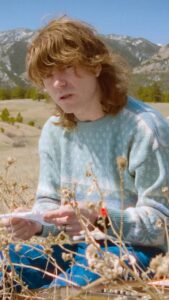
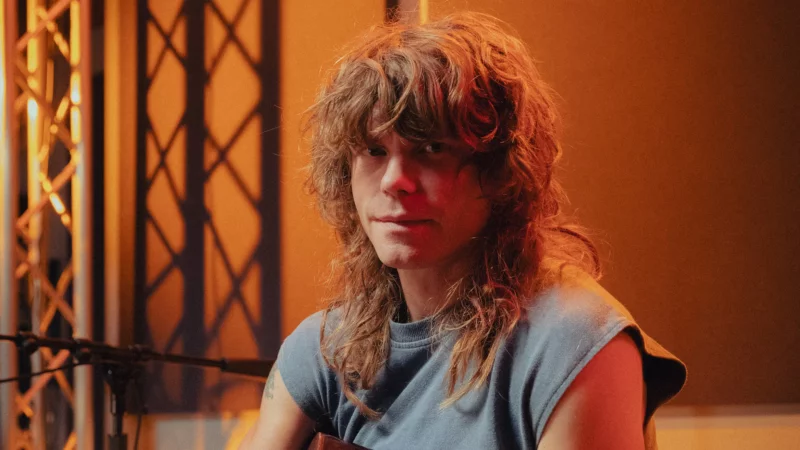
Jesse Welles appeared on NPR’s World Cafe with Raina Durus. A great interview discussion about his history and songwriting, as well as playing a few of his latest songs.
Chapter 1: Interview pt 1
“Folks say that maybe protest music brings about change. I don’t really see it that way. I think that change brings around music and that the songs are just a symptom of a greater ill. And it’s the people and their individual actions that make change.”
Raina Durus: You just heard a clip of the title track from the latest album from Jesse Welles. That’s called Masks Off on World Cafe.
I’m Raina Durus. Jesse Welles is my guest today. Jesse, welcome back to the World Cafe.
Jesse Welles: Hey, thanks for having me. It’s been a minute.
Raina Durus: I’m so happy to have you. I love this record. Why did you choose that song to open the album and to make it the title track?
Jesse Welles: Oh, it seemed seemed apt. It seemed a a good opening for the rest of the ideas that would be uh dispersed through the record that was kind of lead with the chaos that you uh that you’re seeing every day. and which at the chaos it’s kind of a tool to keep you so distracted
that you can’t even really um you can’t even spend long enough on one idea to know that any one thing is ridiculous. Yeah.
Raina Durus: I think it can be a challenge for artists to write music that touches on politics or things that are happening in the world without coming off as trit or
cliche. You manage to avoid that in your music. How do you approach writing about the news? What is your sort of philosophy behind writing?
Jesse Welles: You are a witness. You are mostly agnostic. And instead of listening to somebody’s opinion or ideas that they have about something that has happened, you try to figure out what exactly has happened. What is the epicenter? What is the event that has led to 50 different talking heads to expose their take on it? And then you find that that one central point and then you say it. Yeah. You know
Raina Durus: People have a tendency to call your music protest music. Do you see it as protest music?
Jesse Welles: People got to call things something. They need names and they need to organize it. They need to place it in their mind someplace where they feel like it belongs. Folks say that maybe protest music brings about change and stuff, but I don’t I don’t really see it that way. I
think that change brings around music and change brings around art and that the songs are just a symptom of a greater ill. And it’s the people and their individual actions that make change.
Raina Durus: We’re going to hear you perform a song now and then we’ll come back and talk some more. What can you tell us about the first song you’re going to play for us? Meet the new swamp.
Jesse Welles: Same as the old swamp.
Chapter 2: [Meet The New Swamp]
Chapter 3: Interview pt 2
Raina Durus: Live for the World Cafe. Meet the swamp. From my guest today, Jesse Welles. I’m Reena Durus. Jesse, you even before this interview started, you were sitting there strumming your guitar. It seems so natural. It almost seems like an extension of your body at this point. But when you started, I understand you actually had no idea how a guitar worked. Could you tell us about those early days learning to play guitar?
Jesse Welles: Yeah. Um, I bought one money I’d saved up when I was probably about 10 and um, [clears throat] grandma would give us I think like five bucks an A on a report card. And so three report cards go by, you got about 60 bucks or so. And they sold guitars at uh Walmart, little First Act brand ones. And I think it was 62 dollars maybe 7 something cents. And I got it and I got it home and I had never really seen anybody play a guitar. So I thought the only way to really change the sound of a string was to just turn the the tuning pegs. I thought the Beatles were turning their tuning pegs really quickly and broke a lot of strings on it real quick. Of course, I didn’t know really what to do about it. Nobody in my family played or I don’t remember anybody even coming back there and seeing how I was doing with it. I just I put it away. I was I still I was still just a kid. And then we moved down into the River Valley in in Arkansas. I had the guitar and I would still plink around on it. And the neighbor down the road uh saw me with it. He’s an older gentleman. He had two mules. They were named Bill and Hillary. And he drove like a 1952 Chevy that he had. Anyway, that’s besides the point. But he came down and he told me that he would show me how to tune it and uh and how to play. and he and he showed me how to play camptown races and other little melodies and how to put my fingers on the fretboard. And once I had gone down and and played a little with him, I was, you know, I was toast. I just played it non-stop from probably 12 or 13 years old, until um just a moment ago.
Raina Durus: If you’re just joining us, my guest on World Cafe today is Jesse Welles. So, you’re this kid playing music in Arkansas. Could you tell us about the town that you grew up in? You sort of painted the picture of this old man down the road with his old truck, these mules. What What was it like growing up there?
Jesse Welles: Um, I thought it was really nice. It feels like all of being a kid was learning how to write cursive. long division and fishing. Uh, I’d lived so far out that I didn’t necessarily have a lot of people to play with or anything like that. So, it was very much like build a fort, um, play by yourself and make believe and and and that sort of thing. It’s romantic now. At the time it was mundane. Yeah.
Raina Durus: Was there a place where you could see music or go play it as as you got older when like if you were in school, you’re all in a band.
Jesse Welles: We didn’t go to concerts or or anything like that. Um, but the the school band had a uh drum set and uh so me and my buddies, you know, we would all play on it and we would set up and in the gym for every little pep rally, every opportunity we had. And then there was a there was a barbecue restaurant downtown and they would let us go down there and we just played blues music. It was um we yeah we had a little group called the the stimulus package um which I I got a real kick out of that was um in the zeitgeist at the time. I think that was probably around 06 78 something like that.
Raina Durus: We’re going to hear you play another live song now. It’s called Won’t You Come Out Tonight. Where are you taking us in this song?
Jesse Welles: Um I guess we’re going to Ozark. Um, but that’s the thing is like I wrote it up in Estus Park and I was out there on Halloween and they closed down all the shops and all the kids got into a parade and the shop owners were handing out candy. I got such a kick out of it. You realize all these mountain towns are special and have their little differences, but they are all the same. And it reminded me of being a kid and I wrote this tune just about being in love and a mountain town. Yeah.
Raina Durus: Here’s Jesse Welles performing Won’t You Come Out Tonight live for World Cafe.
Chapter 4: [Won’t You Come Out Tonight]
Chapter 5: Interview pt 3
Raina Durus: Performing a song from his new album, Masks Off. That was Jesse Welles with Won’t You Come Out Tonight live for World Cafe. My name is Raina Duris,
hanging out with Jesse today on the show. A few years ago, you started filming yourself performing in the woods in Arkansas, and those videos and those songs started getting a lot of listeners, gaining a lot of traction. How did you first think about approaching sharing your music on social media?
Jesse Welles: Um, I saw a lot of other folks doing it and I thought, I’ll I’ll do that. [laughter]
Raina Durus: Fair enough.
Jesse Welles: Um I didn’t it seemed like what it seemed like the new format seemed like the the way you go about it.
Raina Durus: So what was your reaction when you started to see these songs were resonating with people?
Jesse Welles: Um initially it’s like oh god I can’t watch. Um, [clears throat] so I didn’t and I don’t but it did tell me to write more and to do more and so that’s that’s what I did.
Raina Durus: You have written a lot. I mean over the last two years I think you’ve put out eight full length albums. What happened in 2024 to to spur this rush of creativity?
Jesse Welles: You know, I had played music all my life and moved to Arkansas, back to Arkansas, after I’d been away in Nashville for about 7 years and I wasn’t playing any music at all and was really trying to give it up.
Raina Durus: Why?
Jesse Welles: Um [clears throat] because I thought if I could really scrape it off of myself, then I could see what life would be like without it. I thought maybe it was blurring my vision in some way. Maybe that wasn’t what I was supposed to do and to be doing it all the time was keeping me from doing something that I was made to do or or something like that, you know. Then my old man had a heart attack and open heart surgery and it was all real quick, you know. It’s like February 19th, I think, ’24. And I was up there in the hospital sitting next to him and there’s a reminder that just beside you that life is very short. I thought boy if he if he dies um I knew him for as an adult all of what nine years or something you know that’s all you get to know people for. Life’s awful short. And for some reason, and I don’t know how the book came to me, and I don’t know why I had a hold of it, um, but I did. I had the Woody Guthrie biography, and I thought, well, this is this guy knows how to live life. Maybe this is what I’m supposed to be doing right now. So, I left there, not really sure if he was going to make it or not, and kind of accepted if he hadn’t. I played out that scenario in my head and was trying to get cool with it. Be like, “All right, um, this is what the future would be with your father dead. “What on earth would you do with your time after that point? It’s like, well, try very hard to do something. So the songs started just kind of seeping out. If you really have something in you, you can’t really help it from coming out. You know, you can try to quit music or whatever, but you’ll be driving down the road and you’ll end up making up songs and stuff. They just start coming out by accident and then you know, well, you’re terminal and uh you you got to do it. Now, luckily, dad survived and everything s a-okay. Um but that was kind of the uh Damascus moment or whatever, you know.
Raina Durus: I’m glad your dad’s okay.
Jesse Welles: Yeah, me too.
Raina Durus: To give folks an idea of just how fast this happened, you bought a guitar on the way home from the hospital, right?
Jesse Welles: Yeah. I, you know, I didn’t need that guitar. I had a lot of guitars. Um, but [clears throat] I like them and so [laughter] I went and grabbed I went and grabbed that one. It was a uh it was an emotional purchase. Yeah.
Raina Durus: So, take us into your songwriting process a bit. What does it look like when you’re writing a song?
Jesse Welles: I have a lot of tunes going at any one time. Some of them, especially like a topical tune, it’ll be a whole lot of research trying to get, as I said earlier, like down to the center, down to the epicenter. Why is everybody talking? Not what is everybody talking, why is everybody talking?
Raina Durus: What does that research look like?
Jesse Welles: It means um a whole lot of tabs on your browser and just digging through um public gra digging through a bunch of browser and just digging through um public gra digging through a bunch of garbage [laughter] to uh to get, you know, to get to the point, taking in all that information and writing rhymes all along the way. I suppose the best ones always come when you’re not trying. Uh the refrain will come to you when you didn’t need it or want it or anything. You’re just trying to check out at the grocery store and that hits you and it’s like I’ve got to hurry home. Those moments are like I’m I’m having an emergency. Other times I can’t write anything and that’s also an emergency. [laughter] But yeah, you keep you keep quite a few tunes going at a time and they’re like pans on the stove or something cooking all sorts of stuff at different
temperatures and things get done at certain times and you start other things.
Raina Durus: Yeah. I know that in addition to musicians, you were also influenced by the comedian Mitch Hedber and a lot of your songs are very funny. And I’m thinking of the song Domestic Error on the new album where it almost sounds like there’s a call back to Hedber’s joke, I used to do drugs. I still do, but I used to play clip that right now.
The Navy Seal came to me. He said, Boy, I’m going to tell you the news.
I said, “Aren’t you CIA?” He said, “I used to I used to, but I still do too.
So, we chewed our creatine gummies and I wondered if he was lying.
I said, “What do you know about Vegas?” He said, “What do you know about dying?”
He said, “It’s going to be a bloody 25.” He said, “There’s going to be some loss of life.”
He gave me a one time code for 10% off Bluetooth and collagen peptides.
Hotels and spaceships, Teslas, and tunnels are fine.
Folks get too close to the big white house and they lose their goddamn mind.Raina Durus: So, how do you think about using humor in songs to add clarity or to, you know, approach stuff that is sometimes pretty heavy?
Jesse Welles: Uh, you know, Guthrie said if you got something to say and it might be a bit provocative that you can say it and duck or say it with a big smile. Um, and maybe nobody will hit you. You know, I think sugar helps the medicine go down. And I like to laugh. A song can just be a whole row of punchlines. Why not? And so that’s where a tune like Domestic Error gets… Yeah.
Raina Durus: There’s a song on your new album called Technopagans. We’re going to hear you play it next. It gets into Silicon Valley and tech and AI. I want to ask you as a creative person and a prolific songwriter, what is your view on AI and and the way it’s being sold to us right now?
Jesse Welles: Yeah, I guess it is being sold to us. I kind of thought that we were being sold to it. It’s backwards looking. It takes on your data sets and uses that to make derivative content instead of humans making progress forward content, making something out of nothing. It still needs fuel to make things. We don’t we don’t much we can’t much help. I think if if humans have anything anything that they’re supposed to do, it’s probably to create things. And I don’t mean that everybody is a fine artist or or something like that. I don’t like I’ve said this before, but I mean it a great deal is some folks make spreadsheets and some folks make tables and some folks make wondrous theories and some people make paintings and other people make songs and we’re just supposed to be making something. And if you want to find the places where people have either relinquished or have had the ability to create things taken away from them are some of the most miserable places on the planet. And those places are working and laboring and laboring for your life. And absolutely no shade to anybody cuz I’ve we all have to work. Listen, I understand that and that’s pragmatic and stuff, but when you essentially become some some servant to a company or totally beholden to your manager at the McDonald’s, then you’ve had the ability to really create probably taken away from you by a situation a lot bigger than yourself.
Back to your AI question though. How do I feel about AI? I am slow to get upset about maybe some of the things that I hear folks upset about. There’s a lot of there’s a lot of anxiety about being replaced. Artists being replaced, jobs being replaced. I said on that first record, everything that can be replaced will be replaced. And that’s how it’s been since the dawn of time. There’s nobody running a switchboard down at AT&T anymore, connecting calls. That job’s gone. There’s hardly any friers chewing horses and we’re certainly not riding horses to our engagements around the town and stuff. And so the horse lost its job, you know, and uh the saddle maker and the tack wear maker. Things will be replaced. But I don’t see how AI could really replace human art. We are so flawed and inconsistent and complicated. How could that be recreated? And it’s what whether we know it or not, it’s what we love about one another when we when we look at art.
Raina Durus: Jesse Welles is my guest on World Cafe. He’s going to perform his song Technopagans next. Is there anything you’d like to tell us before we hear you play it?
Jesse Welles: This tune is kind of a spiritual movement going on and has been going on like in Silicon Valley. You see leaders in that industry, someone like Peter Thiel going around doing lectures on the Antichrist, saying that environmentalists, bloodites, people like Greta Thunberg are antichrist demons when wouldn’t you think what’s more dangerous for humanity is to continue to allow artificial intelligence grow at a rate faster than human cognissance? You do not know what you’re doing, but to admit that you don’t know what you’re doing, that would hurt shares. [laughter] This tune is probably chapter one or chapter two of my my getting through it, my trying to wrap my head around it. There’s a bit of resignation in this tune, but it it may not be that way forever.
Chapter 6: [Technopagans]
Chapter 7: Interview pt 4
Raina Durus: You’re listening to World Cafe. I’m Raina Durus and my guest today is Jesse Welles. You just heard him performing a song Technopagans from his new album Masks Off. You are very straightforward in your songs. You directly sing about things. Are you ever worried about or do you ever think about negative reactions you might get from people when you’re writing?
Jesse Welles: You can’t write a song like you’re playing chess or something like that. You shouldn’t be writing a song thinking about second and third wave reactions to a song. All you can really do is make the art as it as it comes out and as it’s true to you. Otherwise, you’ll get caught up in making something for somebody else. Um, and it’s not even you’re not even actually making it for somebody else, you’re making it for somebody else that you’ve imagined. So, that person would be probably very critical the way the mind works. you know, you would make up the anti- whatever you are, you know, and then you would be trying to write to that imaginary figure. That sounds like it’s not fun. And so, you just write um, exactly as it comes to you. Maybe folks will get upset and maybe folks will be really glad. It doesn’t much matter cuz you’re just doing your thing. Like that’s all you just have to keep going.
Raina Durus: So the last song that you’re going to play for us is a song that you’ve said.
Jesse Welles: I guess it’s a song about being me.
Raina Durus: Tell tell us a bit about this and not some other way.
Jesse Welles: Yeah, I guess this one’s a little self-indulgent. I just wrote it. I must have—I did a terrible thing and I wrote how I felt. [laughter]
Raina Durus: You’re awful.
Jesse Welles: I know. Real rotten.
Raina Durus: How dare you?
Jesse Welles: Um and lo and behold, it can be cryptic or complicated. We contain multitudes. So, kind of talking about things that are uncomfortable and how at the end of the day things are just what they are and you get to be okay with that or not, but you’ll probably live a little longer if if you would be okay with it. Yeah.
Raina Durus: Live for World Cafe, Jesse Welles. this and not some other way.
Chapter 8: [This And Not Some Other Way]
Raina Durus: That’s a song from his new album, Masks Off. Jesse has been my guest today. It’s been so so great having you here, Jesse. Thank you so much.
Jesse Welles: Yeah, thanks for having me.
https://www.npr.org/2026/07/13/nx-s1-5891757/jesse-welles-album-masks-off