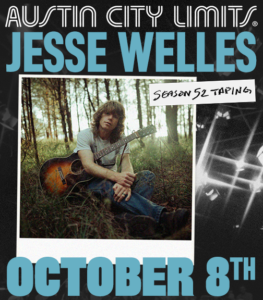
Jesse Welles: Unmasking the News, Technology and Pete Seeger’s Hudson River Legacy
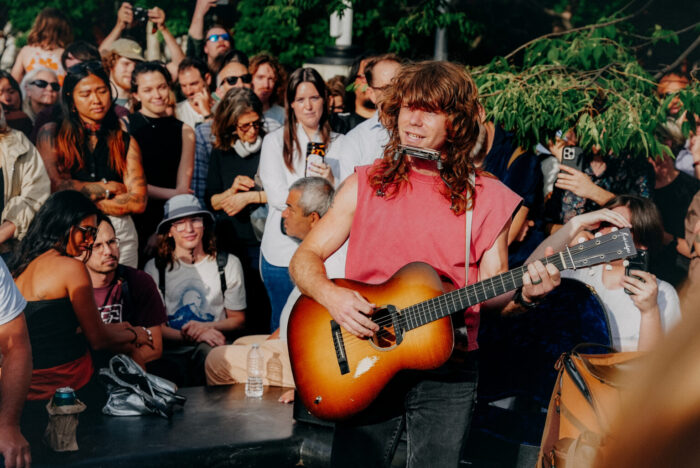
Jesse Welles has arrived at his ancestral home, at least musically. It’s a hot, not-quite-muggy early June evening and the 33-year-old, Ozark, Ark.-bred folk singer is standing in New York’s Washington Square Park preparing for a pop-up show, a few days before the release of his most recent album of politically charged songs, Masks Off. Washington Square Park has long been a Mecca for free thinkers and counter-culture types and many of Welles’ musical heroes got their start congregating just a few feet away. The area is still a magnet for buskers. In fact, before Welles appeared, a sizable crowd developed around another rootsy combo that happened to set up shop under the park’s signature arch, with fans who had gotten wind of Welles’ surprise set mistaking the acoustic players for some sort of warm-up act for his mini-show.
When the rising musician does eventually emerge shortly after 6 p.m. a little deeper into Washington Square Park—closer to the Greenwich Village space’s iconic fountain—he blends right in with the crowd of onlookers, offering a mix of topical originals and a cover of John Prine’s “Angel From Montgomery,” with special guest Margo Price sliding in to sing as well. Yet, while Welles is clearly indebted to a folk tradition ignited by Woody Guthrie, Pete Seeger and their brethren, with Masks Off and much of his music in general, he’s addressing decidedly modern concerns—the album’s title-track rallies against the I.C.E. surge in Minnesota, the abduction of Venezuela’s leader and the post-D.O.G.E world while “Technopagans” is a warning about AI and technological overlords. “There’s a resurgence of spirituality, or maybe religion, in Silicon Valley and [Peter] Thiel got in front of it and might have seen it coming and was able to position himself so that an environmentalist—or somebody who is just pro-earth in general—may be seen as a luddite and an anti-Christ as opposed to supporting the technical growth that’s moving faster than human cognizance and the dangers that might exist there in,” he says a day earlier, while filming a video session at Relix’s New York office.
Masks Off is, somehow, already Welles’ sixth album of original music since he decided to “sing the news” in early 2024, while sitting at his father’s hospital bedside. Soon after, Welles started churning out music at an incredibly fast clip, recording songs in the forest and uploading them to social media, where they quickly spread. He also began barnstorming the country, playing over 250 shows a year and scoring both a Grammy nomination and the respect of his musical heroes along the way.
In the coming months, following Masks Off’s June 12 release, Welles will hit the road once again for another round of marquee dates. He will also headline a major festival for the first time when he appears at Croton-on-Hudson, N.Y.’s Hudson River Music Festival—an event that grew out of Seeger’s long-running Clearwater/ the Great Hudson River Revival—alongside Price, Cimafunk and a unique pairing of Warren Haynes, Daniel Danato and Grahame Lesh, among others.
Before his busy summer truly takes off, Welles spent time digging into his latest collection of songs, his dynamic live show and the weight of carrying Seeger’s legacy down the road one song at a time.
Let’s start by discussing your new album, Masks Off, which you recorded during an incredibly impactful time for both your career, which was really starting to take off, and our country in general, which is in somewhat of a perilous state. For a few years, you have shared your new music seemingly in real time on TikTok and YouTube before recording those same tracks for proper studio releases. At what point did you feel like you had enough material to batch into what became Masks Off, which, to my mind, feels especially cohesive thematically?
I think I put out the song “Masks Off” itself on Jan. 1 or maybe Dec. 31—or something like that. I’d been over in Europe doing a tour. During all that time, so much news had gotten past me, so instead of popping in on different topics like I tend to do, you could just see an entire narrative moving along. I think that was the first time that I really wanted to address this whole movement—that the masks are off, things are just done out in the open and hate is open carry. Hard power is real and being advocated for by very powerful people, albeit very few people. A few people hold a lot of the wealth and a lot of the power in this world. So, that was the impetus of the tune “Masks Off.”
The tunes themselves, some of them were written last year, while on tour, and some of them were written just before I went out for tour. As you said, all of my tunes start as YouTube videos. We were recording them out in the woods. I don’t know exactly what they tell the story of—I didn’t really pick the tracks in order to convey some broader narrative. I just see them as patches in the quilt of ‘25 and ‘26.
You tracked Masks Off during three separate sessions with Eddie Spear, who our readers might be familiar with thanks to his work with Zach Bryan, David Shaw, Sierra Ferrell, Old Crow Medicine Show and many others. You have called your connection non-verbal or almost telepathic. Can you describe how your work together unfolded this time around?
The first session, we probably went in and did “Red,” “Domestic Error” and “This and Not Some Other Way,” simply because we had some time. We had a week before I had to take off. I came in and I just played him what I had—what I knew that I wanted to put the full band to or to have produced. And Ed does what he has almost always done with me, and that’s just mic the guitar, mic the vocal and just do takes, without having to do punch-ins. We’re not really seeking perfection theoretically—just perfection in the performance, warts and all. Those are the kind of takes we always get when doing this.
We’ve known each other for about a decade now, and he and I are able to work very quickly without having to communicate a whole lot. He knows what I want from myself, and I have an idea of what he’s looking for from me, although sometimes he’ll surprise me. But because we have that understanding, there’s really no need for any kind of pretense or, say, for him to click into me at the end of the take and say, “You know, that was really nice. And if you want to keep that, we can keep that, but I’d like you to try one more time.” All the time I just took up to say that, we don’t use any of that time.
We’ll get to the end of the take. He’ll know I didn’t like it. I’ll know he didn’t like it. We’ll go on, you know? We get what we want out of that process. He’s so intelligent that, a lot of the time, I’m just in awe of him while I’m in the recording room, and it humbles me to the point where I do feel like a kid with a few dumb chords and some silly words and a bad voice. He is able to orchestrate things around me musically—ideas that I’m incapable of ever having. So I really like working with that. I always have. That shorthand is so important for the creative process.
Folk songs are, historically, very improvisational and you have famously said that you are “singing the news” in your music. Your tunes also have multiple lives. You release them digitally, you record them for a proper album and then you play them live on tour. Do you consider the recorded version to be the final version and, if not, how much leeway do you give yourself to change your material once you are on the road and grappling with another day’s news?
It’s a little bit of both. They’re never really done. I’m never opposed to changing them once I’ve put them out or once I’ve gone out and I’ve tracked it myself. I’ll change the title. I’ll change the verses. I’ll change the chord structures and all that sort of stuff. Really, I just see that as kind of the raw material to work with. [The album version] is certainly a finished version of it, in the same way that songs are so much a product of the moment that they were made in. They are a product of that time, and I think that songs belong in a certain time. So in that way, it doesn’t make much sense to change things sometimes—sometimes they are very much finished because that song belongs to March 25, 2024, and today is a different year and a different day. And there’s no sense in beating a dead horse or anything like that. You can’t get too precious with any of them—make a new one, move on.
Speaking of changing your song titles, one of the tracks on your new album actually had a different name when you first wrote it.
“Won’t You Come Out Tonight” was called “A Pirate Looks at Oblivion,” which was just a joke. Jimmy Buffett has a tune called “A Pirate Looks at 40” or something like that. And I thought, “Well, what if instead of looking at 40, he looked at the void?” I got a kick out of it. But no one else did, which was definitely OK. So when someone suggests that I change the title, like a friend of mine did, I change the title. I’m not precious with it. Sometimes it’s good to listen to your friends who say things like, “The title of the song should contain some words that are actually in that song.”
But I also like it when [artists don’t change lyrics in their music, even when the references are dated.[ That’s how a song belongs—in time.
You had been performing and recording music for around a decade before you started to release protest music under your own name and began to really gain traction. You made the decision to start singing the news while reading a Woody Guthrie biography as you were sitting by your father’s bedside in the hospital, after he suffered a heart attack. How did Woody’s music originally enter your world, leading to this change in approach?
I had always known about Woody because, when I was a teenager, I got ahold of Dylan’s self-titled record, and it had “Song for Woody” on it and, of course, I was like, “Who’s this Woody?” And so I go down to the library, where I’d gotten the Dylan tape, and they had a Guthrie tape—a Woody Guthrie anthology—and I went, “He’s probably talking about this Woody.” So I listened to him and, sure enough, there’s no way he’s singing about some other Woody. And so there that was.
So I knew “Hard Travelin’” and I knew “This Land is Your Land” and I knew “Riding in My Car” and some fun tunes—stuff that, as a 14 year old or a 13 year old, I didn’t necessarily understand. “Pastures of Plenty,” I didn’t necessarily understand the history behind that either. Fast forward, and I’m 30. My dad had just had a heart attack and open-heart surgery, and I was sitting up in the hospital with him, and I had a Woody Guthrie biography with me. Honestly, I couldn’t tell you where I got it, and I don’t know what I was doing with it. But of all the books to have in the hospital, I happened to have that one with me. I was reading it and thinking, “If he dies now, I’ve known him all of 30 years. And of that, really, I’ve only known him about nine of those years.”
He didn’t die, but I didn’t know that at the time and I thought, “If he dies now, life is very short, and it’s moving past us all the time, or we’re maybe moving through it all the time, so I had better do something.” And having the example of Woody in that book before me, I thought, “Maybe this is what I should be doing.”
You had already been through the music industry ringer at that point. You played in bands, went to Nashville and even worked with Dave Cobb. Where were you, musically, when your dad had his heart attack?
I was at a point where I had pretty much given up on music, and I wasn’t playing anywhere. I wasn’t doing anything with it. I was just kind of sitting on my hands, trying to figure out what I was on this earth for. Singing the news, I didn’t know that’s what I needed to do. I wasn’t sure about anything, but I just decided to do it, and I felt very stupid for a lot of it, and I still do some days. But I just keep doing it.
The music that I had played all through my 20s was rock-and-roll music—I’d always had a rock-and-roll band. And, at the time of my dad’s heart attack, I had moved back to Arkansas in 2021. All music was kind of taken off the road, especially unsuccessful music like mine, at that time. And then I was playing country music in bars. I was mostly an acoustic-covers guy, and I would go and play Glenn Campbell and Tanya Tucker songs. It was not even really country music that people wanted to hear—it was just the country music that I was willing to play because that’s what I liked. I wasn’t gonna play anything else. I didn’t feel like learning “The Thunder Rolls” or some of these songs—“Big Green Tractor” or something like that. I just didn’t really want to play any of that. But I was still playing these soul-sucking cover gigs at little bars for about five, six or maybe 10 people that would kind of move in and out over the course of the evening, and I’d work for tips.
So I had gone from being signed and at least living in Nashville, even if there was nothing going on, to then living in a very small town in Arkansas, playing to five or six people. I had failed at whatever I had set out to do and whatever I was looking at was not a success by any means. And so that’s where I was at. And then with my dad—it looked like dad was dying, so things weren’t looking too hot. But then I decided to change course.
Though you regularly discuss current events in your songs, your music is also very personal, and you continue to look inward with your lyrics as well. While all original music is, to some degree, personal, how do you balance your more introspective songs and your more topical tunes on a given project in order to make it feel like a well-rounded effort?
With Masks Off, so much of me is stuck in it. Middle, which was three records ago now, I felt was pretty personal as well. [He takes a long pause and looks into the ether.] You know, honestly, I don’t think of the balance of it per se. I just kinda say, “These are the songs that I’d like to go forward with.”
You are headlining the Hudson River Music Festival on June 21. That festival grew out of Clearwater, which Pete Seeger established to clean up the Hudson River. You have described him as an architect for everything you do. When did you first become aware of his music?
Pete Seeger, I heard through a friend. It was in 2011, and he showed me a recording of “Michael, Row the Boat Ashore,” with all the children singing. And I thought, “This is incredible.” It was really an emotional thing to hear them sing “Michael, Row the Boat Ashore,” and that was my first entry into Pete Seeger. And from there, I went down to the library again and got the Pete Seeger collection that they had. And I became acquainted with a lot of his union tunes and stuff like that. And then I learned about him more, honestly, in the Woody Guthrie book I read because Woody was, at a point, traveling with Pete Seeger, and they were doing shows together. You can still listen to some of the radio shows they did together. You can hear the whole cast of characters—what a time it was to be alive.
Looking ahead to your Hudson River set and your upcoming tour, now with six albums under your belt and likely more songs on the way, how do you construct your setlist each night? I know they are quite dynamic and change throughout a given run.
I’m still figuring that out. There’s so much music that you could play for any set, you know? And you can look out into the audience, and you can kind of guess who’s here for what. Some folks are really hollering out, and they really want to hear protest tunes. Some folks really want to hear “Bugs” and nature songs. And then some folks really want to hear personal tunes of mine and I just try to balance the three or four different genres that the Welles band kind of has right now. I try to divvy the set into segments so that everybody gets something that they came for. Nobody’s going to get all of what they wanted. And that’s just life. I don’t get all of what I want, you know? But I just try to pick things for everybody, and it changes up, and it’s going to continue to change, especially as we move into outdoor venues and we play the Hudson River Music Festival. We’ve never headlined a festival. So, we’re planning on having a sprawling show and going deeper into some tunes than we normally do and really exploring, sonically, what the five of us are capable of up there.
You must feel pretty confident and comfortable with your current band to change the show so regularly, often on a dime, depending on the audience’s vibe.
They’re so talented. They can really go in any direction. Sometimes the best thing for me to do is to actually just not play. So, I try to get out of their way.
Festivals have long been a part of the folk tradition and important community-building events in general. As you mentioned, this is your first time headlining a fest of this stature. What does playing the event mean to you going into it?
It’s an honor to be part of the Hudson River Music Festival—to carry the legacy, carry the torch that Seeger lit years ago. He kept it going for so long. When you think about singing the news or really doing any type of protest music—or topical music or awareness music or however you want to put it—you go back to Pete Seeger for the template. That’s where you start and everything else is an augmentation. Between he, Woody and those that traveled on with them, they really began the tradition in America. So to aspire to be in league with those guys, that’s a true honor.
During the past few years, you have had the opportunity to meet and perform with a number of your musical heroes and early idols. Is there an established musician who you’ve engaged with that’s offered you some particularly impactful advice or shaped your musical outlook?
Yeah, meeting Joan Baez and then going in and recording with Joan and getting to the point where now, when I’m over in California and I’m by her, we’ll go and get lunch. We’ll go and get dinner, and she’s gotten to know my wife. What I’ve learned from her—and this might seem like whatever, but I get a kick out of it—is that she is never too serious. I think it must be very important to mentally age so gracefully, to never really crystallize, to never really become hard and cruel and to remain supple and flexible and to be able to take on new ideas—all while keeping your core principles about you. I think that that’s something Joan has perfected and something that I aspire to attain at some point. She’s just having fun and she knows when to just laugh.
You are currently in the midst of rolling out a new album, which requires spending a lot of energy on promotion and often forces you to look backward a bit. As a prolific songwriter, do you find that this juncture in an album cycle is a natural time to take a step back, or does it push you ever more to jump back into your creative process?
There’s no time to stop, no time to think, no time to look back or anything like that. I’m glad that those tunes will be out, and I will feel that, once they are out there, a weight has been lifted off me, and I’ll feel as light as a feather. And then I will hop down the road for new tunes.
https://relix.com/articles/detail/jesse-welles-unmasking-the-news-technology-and-pete-seegers-hudson-river-legacy/
https://archive.ph/Ow53A
Jesse Welles Unmasking the News – Relix