
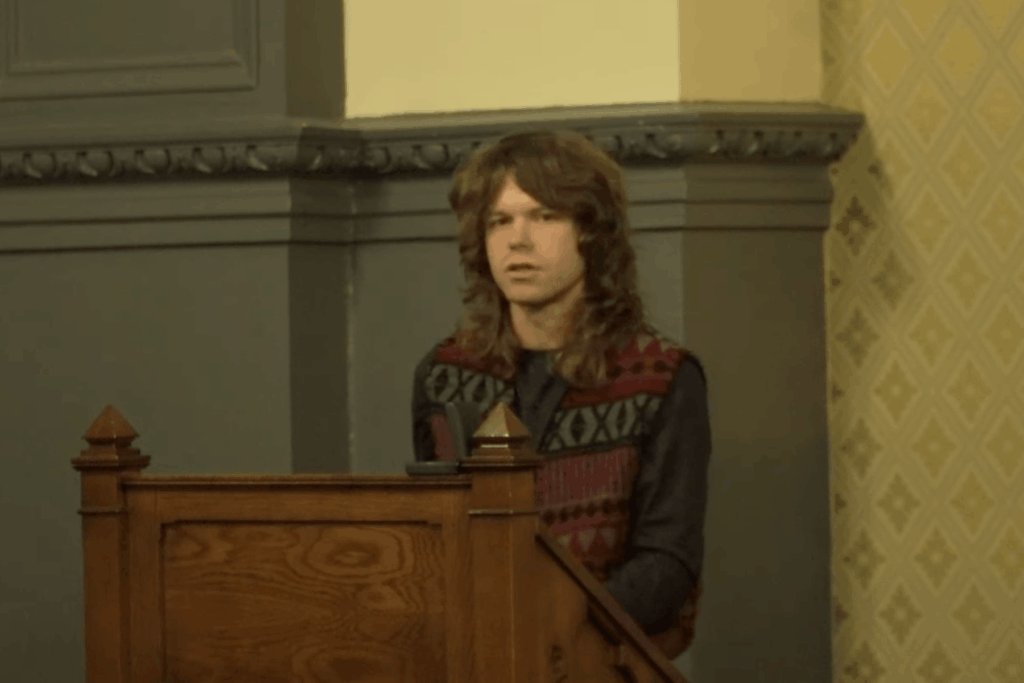
Grammy-nominated musician Jesse Welles speaks to the Phil on all things music and his body of work.
The Phil is the world’s oldest student society, founded in 1683 and situated in the Graduate Memorial Building in Trinity College Dublin. We’ve hosted some of the world’s finest, both as members and as Honorary Patrons.
The 341st Session of The Phil.
Introduction (presenter)
All rise. Thank you. Thank you. Hello everyone, ladies and gentlemen. Welcome to the 11th Bram Stoker Medal of Cultural Achievement for the 341st session of the university philosophical society. Before we bestow this award to Jesse, I’d like to talk briefly about what the Phil is, what we do, and what we endeavor to achieve.
The Phil is the world’s oldest student society and has recorded the presence of many remarkable members from Oscar Wilde to Bram Stoker to Samuel Beckett across 341 years of history. Today we have 10,000 members from all corners of the globe. Every year our council selects an elect number of people to attend the society and give an address based on their significant cultural achievements within their respective fields. It has in the past included figures such as President Joe Biden, Angela Merkel, Archbishop Desmond Tutu, Bono, Courtney Love, the Cranberries, Hozier, Whoopi Goldberg, Helen Mirren, and a wide number of Nobel laureates, world leaders and Oscar and Grammy award winners.
This year, our council has elected Jesse Wells to the honor of receiving the Bram Stoker Medal of Cultural Achievement for his contributions to music and political and social discourse. Originally from the town of Ozark, Arkansas, Wells commenced his career in 2012 by releasing homespun recordings via Bandcamp and Soundcloud. He formed bands called Dead Indian in 2012 and eventually released singles, EPs, and albums through his band Wells, as well as the band Cosmic American. Over the course of 13 years, his style has offered a blend of rock with roots and folk that has led critics to hold him in the tradition of Woody Guthrie, Dylan, John Prine, and Pete Seeger. This has culminated in recent years with recent success on Instagram and Tik Tok producing songs through acoustic formats talking about current political issues with songs such as Fentanyl, War Isn’t Murder, and others which have led him to be known as the revival of the modern protest song. Wells in many ways has not only brought a style of political songwriting back to the forefront of digital algorithms, but he’s also maintained this with a commitment to his folk roots and continues to provide searing commentary across all facets of political discourse. He joins us in Ireland today and will be headlining the Olympia Theater in town this coming Friday the 5th. We’re immensely excited to have him joining us. So, I hope you join me in applause as we welcome Jesse to the Phil and honor him with this award today. Thank you very much.
Jesse — acceptance
Far out. All right, gang. You know, thank you. I feel like I should be giving this to you, Liam. You are actually articulate. I got some notes. I’m going to say a few things. I normally sing. I’m a bit more comfortable doing that, but we’ll get through this. I got some unsolicited advice. And I don’t know what else. I kind of—this is going to be a surprise to me. I’m going to say a few things. So, ready? All right. Here we go.
I never got any awards in school or anything like that. Better late than never. I know this isn’t for my grades or anything. But you know, I appreciate it big time. You can’t really wait around for opportunities to show up to you. Life is real short. And there’s a lot of folks probably a lot of folks in this room that are real talented, got skills that you’re developing right now. But kind of the truth of it is it’s not a whole lot of folks advocating for you necessarily. It’s something to go ahead and learn early. You got family and friends if you’re lucky and that’s about all you get in this world.
It’s a scary thought at first, but once you get past being scared, you realize that you’re super free. It’s a total freedom. It’s you and the world, and that’s all it is. And all you got to do is figure out how to be you in the world. There’s no gatekeepers. Folks are going to talk about this time that we’re living in right now. They’re going to wax nostalgic about it. 20 years from now, they’re going to go, “Man, if I’d have only been if I’d have been 22 in 2025, I could have really slayed.” You know, and I know that because they do that every generation, every few decades you say it, okay? There were Civil War generals in America saying that they wish they had been fighting with Alexander the Great. Okay, people always talk about they get nostalgic. That’s for another discussion. But the thing to know is that there’s really no rules right now as far as art goes, as far as getting your art out in front of people. I’m a great example of that. Literally just songs and an iPhone and that’s it. Throwing stuff up on the social media. You just kind of—I don’t know. You got to make a deal with yourself. You don’t really need school. It’s good that y’all are here. Okay. I’m glad you’re learning. That’s a good thing. I’m sure Trinity appreciates that. I say that just to emphasize there’s no rules, okay?
All you got to do is make a promise to yourself that you are what you want to be. You’re a writer or you’re a singer or you’re a very good programmer or you make really good pies. You just got to make a promise to yourself and pursue that without relent with no abandon. And you don’t tell no one. You just do it. And you finish what you start knowing that the thing that you’re making ain’t the last one that you’re going to make. It’s not the last book that you write. It’s not going to be the last song that you make. It’s not the last program you code. It’s not the last pie you bake. You just finish it, learn what you can from that specific project, and move on. If we’re alive for any reason, if there’s a purpose for us being alive, it’s to create stuff. Don’t compete. Just create. Don’t look over your shoulder. Don’t look over beside you trying to size up when someone else is doing it. It does you no good. You’ve got a destiny that nobody else has. It’s just a matter of going out and getting it. Anyway, thanks guys. Thanks for the medal. Thanks for the philosophical society. Thanks all. Thank you very much.
Q&A — (interviewer and Jesse)
Influences
And welcome once again. I’m going to ask you a few questions and then we’ll open up to the floor. I think there’s a lot I want to ask particularly about your process and more particularly your recent process with songwriting. But I think I’d like to start with the why. And I was reading about your origin getting into music particularly through Beatles collections from your granddad growing up in Ozark and then also coming across you know the likes of Dylan and but more particularly you said that one of your real musical inspirations came from when you first started hearing Kurt Cobain. Yeah. Do you think you can pick out different influences in those early years for you and say they’ve helped inform different parts of your musical process and your various eras as it were? Or do you think you take you know little things or collective things from all of them at once?
Yeah. When you’re just a kid, you don’t necessarily have a lot of autonomy as far as what media you’re going to take in. You’re kind of a bird in the nest. And whatever gets dropped off, that’s what you eat. And that was those Beatles tapes. That was just what was dropped off. I was like 9, 10 years old listening to that. And I go, “This sounds nice. I like this. Other people feel that way too about the Beatles.” But it was once I could go to like the library and check out CDs and kind of take in music besides what was handed to me by family and what was on the radio. That’s when I found like Dylan and really got into folk music. I just liked playing guitar and I liked the way that their guitars sounded and stuff like that. And I liked that the songs were real long and I could play along with them for quite a long time because you didn’t necessarily have backing tracks or anything like that.
But I heard Cobain on the school bus coming back from like a track meet and I’d never really sang before and I heard him sing and I thought, you know, I wasn’t going to sound like John Lennon. I loved Zeppelin. I wasn’t going to sound like Robert Plant. I didn’t have a voice like that. But I heard Kurt Cobain sing and I was like I can mumble and I can shout. So that was kind of the start. I finally opened my mouth and started singing at that point. As far as it being an influence in different aspects of my music and stuff. Yeah. I think it kind of depends on what I set out to do with the tune or something. But it’s also a bit of it gets—you just absorb it and there’s certain mannerisms and idioms and stuff that you’ll you develop a musical vocabulary that you’re not really aware of and you don’t necessarily know that you’re doing a Cobain trick right here or that you’re doing something that you heard John Lennon do or something like that. You just you’ve absorbed it.
Do you ever notice it sort of after the fact? I’m thinking about Jesse’s most recent record, Devil’s Den, came out in August and features both, I should have said, both an acoustic range as well as an electric side with the devil. And I don’t know, do you ever sort of notice in those songs they sort of look at various tracks on there that might particularly sort of draw from different parts of like the Dylan discography electric? Like are there particular moments where you sort of nose up to the fact oh I’m taken from here maybe this reminds you of when I was yeah on the school bus back then?
Yeah absolutely. And I think even with Devil’s Den in particular, I had been listening to the Dylan album Desire a whole lot and I had wanted to sound like him and you get as close as you can but you still just sound like you at the end of the day which is always disappointing but it you know it is what it is.
Doubt and certainty
So, I’m thinking of your address and particularly your sort of desire to emphasize that creation comes first and foremost even if you’re not really sure where it’s going. I don’t know. It makes me think of certain particularly as a song in which you sort of express having doubt particularly sort of as your career evolves thinking about at least from our interpretation sort of coming across new voices having different inter like feelings about your right. Do you think that, you know, is it something you grapple with after the songs come out or is it something you’re sort of trying to incorporate or you notice yourself incorporating, you know, as you’re recording? Sort of those feelings of doubt and uncertainty, I guess, with that. Where do you find certainty?
I yeah, I don’t—I’m only really certain that I’m doing whatever I’m doing. And I don’t really know if I’m doing a good job or not or anything like that. But I think a lot of time like with certain in particular, I just—and you all find this too, you’ll begin to envy someone who is very sure of something. And then maybe also learn to avoid those that are very assured. Because the more you learn, the more you know you can’t really know anything. Not for certain. And so those folks that you hear a lot in the media and stuff that this is black and white and this is this way and this is that way. I you know you—I envy that. What you know wouldn’t that be nice to really know what was completely right and what was completely wrong and stuff like that you know as far as it pertains to music I yeah like I said all I’m really certain of is that I’m making a lot of racket. So do you think there’s I mean do you think it influenced the decision with the way you’ve produced this most recent record sort of—
Devil’s Den and recording process
I look at Hells and I look at Middle and I think you know there’s moments where you sort of are attempting to incorporate both your rock roots along with your folk roots right and here you’ve made a very distinct choice right to produce an album which is predominantly acoustic and then you know bring in the guitars do you think that’s you know those sort of thoughts were involved or… ?
I think like the idea was I had done Hell’s Wells and that was the first one and put it out and that was all just it was all one guitar with a lot of overdubs and stuff but that was just in my room at my house and that was going to be a collection of topical tunes. Then I was like, well, I got all these other songs that ain’t about really one thing or another. Really, they probably have to do with me more than I’d like to admit. Where do I put those? I’m going to put them on Patchwork. And I made another album in the exact same fashion, just on a different guitar. I like guitars. And I made that at the house and so it was I was sitting there and I got these two records out and it was like well what do you do next? Do you do another self-produced one in the in your room, you know, on your computer or is it time to go ahead and get into the studio? Let’s go. Let’s go into the studio and let’s see what happens.
So I had known the producer Ed. I had known him for 10 years or so, but we hadn’t worked together in quite a few years. And so it was somebody that I could trust to take those songs into and put, you know, put drums and guitar on it. Honestly, a neat thing is I didn’t play that much electric guitar on Middle. I really wanted that record to have players on it that had little to no direction from me so that they could have just total artistic freedom and operate without any kind of boundary and that way they would really be able to access the best in them and put that onto the record, you know. And I felt like they really did that way and it was better. I needed to expose myself to the notion of really not having that much control over the sound of things and really just went in with an understanding that this is going to be there will be division of labor and my particular job in the factory that is this album is to perform the song and so that’s really what I did. We would record it live and I would just perform the tune.
Now Middle flies by then it’s like well I got another record. I think all creep no I skipped one in there but then it was Pilgrim and it was like what we’re going to do let’s go back into the studio and I said I don’t want any drums this time. I never made anything with no drums. Let’s just do this with no drums. I don’t know what it’s going to sound like. Well, sounds really beautiful. I liked the record and it had some really earnest tunes on it. This summer I, you know, Pilgrim was out and I got back from being on tour and yeah, I just I don’t know a big hail storm had come through and beat up all the houses and the cars in my neighborhood and everyone was having their house re-roofed and so it was just like knocking constantly all around me. So I was like, I’m getting out of here. I got to get out of here. And I rented a cabin and I just went and made Devil’s Den with a lot of guitars. So, I don’t know. I kind of got to rambling there, but that was that’s, you know, that’s about all I got to say about that.
Acoustic vs electric / performing
Do you have a I mean, it’s probably not a fair question to ask. Do you have a preference either in recording or in performing at the moment between acoustic and electric? I suppose that’ll be particularly relevant for tomorrow’s shows and new shows going forward as we’re looking at the recent album. In the crowd today are I think nine with us and several of them are members of the band who will be playing over Friday in the Olympia. Oh yeah. Yeah. They’re all up in the balcony. I mean, is there a particular preference at this point in time or you planning to sort of just go with the flow and see?
Feels right. I’m really feeling it out. I have all these electric guitars. Every time I put one on, I feel ridiculous, though. So I’ll probably, you know, I’ll probably stick with my acoustic guitars and just play them like electrics.
Social media songs and pressure
I’d be interested to hear when you’ve been interviewed and you talked about sort of the impetus to start writing the sort of acoustic songs that went on social media, you said that it was paired you to a family shock. Yeah. And it was in many ways comforting. Does it still have that sort of comforting effect to you or as they’ve sort of grown in popularity and become sort of synonymous with your art and what you create? Do you feel there’s an increased amount of pressure there potentially responsibility on you to produce songs like that?
No. It’s really nice like when I see something that I like or that I don’t like, I can make a tune about it and I can get it in front of a lot of people now. And I think that’s pretty rad. If I want to sing about cows or guitars or books or bugs or whatever, I can write to my heart’s content and go out there and just do it under the power lines. And it’s just me out there. And I like being alone out there and just doing a 100 takes until I get it right. I feel like a skateboarder or something, you know? They do the same trick like a million times and then they finally get it and they’re like, “Oh, hell yeah.” That’s what it feels like with the tunes sometimes. It’s just like when you finally got it memorized and you finally spit it out and it sounded good, you just feel great. And that’s fun. And you know, so I can do one about cows and then I can be like, the Department of Defense is out of control and I can go and talk about military private contractors and how they’re drinking American taxpayer money through a straw, you know. I just feel I think I just feel really free. Yeah. Must be liberating in any case.
Writing process — 100 takes
I mean, when you say it takes 100 takes to get that song with cows down, is it particularly in the context of those sort of protest tunes? Is it that it takes 100 takes to get the right words and to sort of shape often a metaphor or provide the right spin on it? Or is it that, you know, you have to put those words—are those words more clear to you and it’s just putting them to the right melody I guess
Right when I get out there I think the song is probably about 3/4 of the way done and then over the course of playing it many times and just being like something about being outside and just all the birds are making noises and giving me a hard time and I’m like I’m going to get it and like I don’t know. It’s just that kind of cooks the song the rest of the way. Sometimes you look at it and you’re like I look funny saying that word and so and that’s something that you can’t really know until you go out and shoot it. You know, you can write all day. You know, a lot of times I’ll write something really metered and using some words that I’ve been dying to use and then find it really doesn’t sing well and you were better off with the simple thing and things get simplified, cooked down out there.
The Factory / private space
I think the comment you made earlier sort of about forming your own factory. Do you think that it really took those sort of private sessions out in the woods to help make that? I keep going back to this interview where you said you had a real desire to seek out your own—I think when you say factory I sort of think of the Warhol term but sort of making your own private space for yourself. Yeah. And making sure that before this art which is interacting with public, you know, the news, and is inadvertently going to be seen by loads of people, making sure that those, at least at that moment, those songs are for you. Do you think that, you know, the Factory came before you started singing the news or has it really only been something that’s been developed after?
Huh. I had, I don’t know, I just I reckon I had everything ready and everything lined up, but maybe not the gumption or the reason to really do it. I could play guitar. I could barely sing. And I had on my sweaters and I just I needed that little yellow guitar and I had to go and be close to a near-death experience. And then I was like, “All right, let’s go fire up the factory.” Yeah, I don’t know. It just kind—it came all at once and I just love it so much. I don’t want to stop. I don’t really know. I guess something really broke off in me and I just decided I had to make tunes all the time or I would die. So—
Open Floor
And I’d like to open up to the floor now. If anyone has any questions they’d like to—maybe. Yes.
Q: Someone from Northwest Arkansas, you said you had to get out to a cabin while they were re-roofing. Was that album Devil’s Den? Where you recorded?
Yeah, it was over in Winslow. It was in Winslow. Gotcha. Yeah. Yeah. They weren’t roofing out there.
Q: I’m a longtime fan. I’ve been listening since Power Lines. I think my favorite song of yours is United Health and particularly the line the ingredients you got make the cake you get that’s really like stuck with me. And I think it kind of surprised me when you came out with Charlie. Cuz it seems to me that they’re really incongruent but maybe I’m missing something there. So I was just curious what the development between those two songs about two different assassinations were.
Yeah. The ingredients you got bake the cake you get? I certainly do. Does that mean that I’m not radically nonviolent? No, it doesn’t. And I really—it when I get cheers on that line and stuff, I understand maybe what other singers have felt like when they got misunderstood in some way or something like that cuz I really don’t think that we should cheer on anybody’s death. I was appalled when the CEO was shot down. And my initial reaction was that no man’s death should be celebrated. And I got a lot of push back on that. Like I put that up on threads and there were a lot of people real unhappy with me, you know, they come in real quick and say, “We didn’t know you as a bootlicker,” you know, and you know, that sort of just kind of internet talk.
But it was in that moment I realized there was going to be—if there was going to be more violence then I would risk having some more unpopular opinions about it. And I think when the Kirk assassination went down, I actually saw it like on you know the videos were still circulating on like X and threads and stuff. It was before they really shut that down. And so I was about to go and get the free speech in Americana award like that evening and I just watched this guy’s neck explode and just kind of he just went stiff and then he fell over and they were speculating, you know, was he going to pull through or something. I’m like, I just watched that dude die. He’s dead. There ain’t no way. That really bugged me. And then go through that evening at the awards ceremony and receive the award for free speech and I’m just thinking to myself all that evening and a little bit that next morning like you really do got to be able to say whatever the hell it is that you want to say without the threat of mortal violence. That is what makes what I do possible.
I can’t—I think that there are countries in this world where I can’t do what I’m doing, where I couldn’t do what I’m doing, where I would have just been put away really quickly. Something would have happened. Nothing really goes down where I’m at, you know, like I’m still safe and that I can still appreciate, you know, so I can understand how folks would be led to believe that this is an incongruent opinion, but it’s only because they may have misunderstood or really kind of located their emotions on my first take. So, just if that answers your question. I know it’s a long tale, but it’s worth explaining. I think about it a lot, too. Thank you.
Q: Yeah. Go ahead. Hi. So my question for you, I also come from small town America. My condolences. And I was in an area that had a big go to say a big political swing from the point of to the present. And I think that having, you know, was there for 20 years in that shape, when I found music, three years ago now, I found it very comforting as a someone with a similar to me was actually seeing the crazy shit going on in the world and now I’m talking about it successfully. And so my question for you is I know a lot of your songs are about you the crazy shit some of the more negative things that are happening but I know that you talk to a lot of people wonder if there’s anything that you feel that you see that gets you back for the future.
Yeah, I think it’s like my responsibility to be hopeful and my responsibility to be optimistic. Because it is the harder thing to do. And so I really wonder if that must be the right thing to do. If it’s easier for me to become cynical and hardened and hateful and to say something. This is a sentiment I hear echoed and I’m uncomfortable with it. Although it’s not necessarily untrue. Folks in the South perhaps they voted in their demise in some ways. Okay. And I can understand how that can be argued and stuff, but that really doesn’t mean that the individuals that did it deserve their farms being shut down and stolen away from generations of farmers, stuff like that. The politicians play wicked games and they appeal to our demons and they say, “I’m going to take out I’m going to get rid of that person that doesn’t look like you if you vote for me.” And they go, “Hell yeah, let’s do that.” But they don’t understand that that’s not what’s hurting them. What’s hurting them is huge corporations coming through. What’s hurting them is and this is in farming in particular, what’s hurting them is Monsanto, Tyson, Cargill, Acre Trader, these big acts, right? That’s what’s tearing them up. It’s not, you know, something that makes me that just makes it easy to be optimistic and hopeful is being like I still live in Arkansas, still live in a small town.
I’d say probably 90% of that town doesn’t get on with the way I look at the world 100%. Still, they’re super kind to me. They know what I’m up to and they know they don’t dig that song about Tylenol or something, but they still I think humans when faced with something that they don’t disagree with. Let me back that up. Everybody’s got an opinion until it walks through their door. And when you’re met face to face with someone that you really fundamentally don’t agree with, you have two options. You can be confrontational and maybe even kind of angry at him or you can be compassionate. And the compassionate way is what I see more often. People are kind to me. People are compassionate with me. And you find the middle ground. You find where you fit on the Venn diagram and that at least opens the floor to discourse as opposed to just shouting at one another and saying calling each other names which is a big thing you know so I think you know I’m optimistic there’s a that everybody seems a little bit nicer.
Q: Yeah. Yeah. And I’m curious what inspired that or what is that?
Not the devil. I think anybody claims to know or anything like that. But I think that if there were a bonafide concerted war effort to reach the banks of America, I think Americans would find that they got along a lot better than they did before. That the infighting would suddenly dissipate and everyone would look a little bit nicer when a real problem showed up and not just one of name calling and little I don’t know just the petty things that we fight about. Yeah. We’ll do one more.
Q: Yeah. I was just thinking in your music you seem to manage to talk about these very pressing and in many cases like existential issues in a very witty and sometimes comedic manner. Particularly at a time when like the discourse around these issues is becoming increasingly aggressive and polarized and in a lot of cases people just don’t know how to begin to express their feeling. I’m just wondering like when you see an issue that you feel you want to discuss in your music, how you go about even articulating it and getting those thoughts out in such a clear manner when most people are kind of don’t know what to say at all or just going to the extremes.
Sometimes it’s real quick and real obvious like Join ICE. I’m like scrolling through my phone. I get an ad to join ICE. I go, I know what I’m doing. I’m going to my room joining ICE. No. Immediately I just vomit a few verses and it’s like that’s the tune. That’s the tune. I’ve had these sentiments about these types. Some songs are sitting in you just waiting for something to trigger them and then they just bounce out. That’s a type of person. And that’s a psychology that I’ve been up against my entire life is the big guy, you know, the tough guy.
Other ones are being gathered bit by bit, line by line, and I don’t really know it. I’m just journaling. And every once in a while, something will come out, and it’s like that’s going to be in a song eventually. I don’t know when. Sometimes I can see a subject that I think I want to hit and write the whole tune out, read over it, and go, “No, I don’t understand enough about this to like to really have to really have a really like formed opinion on it.” And so that lays dormant. But then something else happens a little while later. And two things start to kind of converge on each other and all of a sudden I’m going back through files and I’m grabbing three different tunes and borrowing verses from each because it all pertains it all came together. It all pertains to the one thing. So I think I’m just constantly writing and sometimes it’s really obvious that like something is going to earn or deserve like a tune or some attention. Other times it’s I’m going to have to write three or four tunes to get one out of it. So, yeah.
Ladies and gentlemen, round of applause for Jesse Wells.
https://youtu.be/kBptwYm1YXA