Review: Jesse Welles at Freo.Social
Jesse Welles at Freo.Social
Wednesday, January 28, 2026At Freo.Social on Wednesday night, nestled amongst a small entourage of seasoned concert-going veterans, it was difficult to know what a debut Australian tour should feel like. When you see enough gigs, you can’t help but have a certain expectation. For an artist like Jesse Welles, on his first trip to Australia, his tour had sold out in record time, notably due to his ever-amassing online presence. At the end, audiences left feeling like they had witnessed something special, something rare. Not like Bigfoot rare, more like truth rare, the kind that punches you in the chest and then laughs about it.
For those who came in late, Jesse Welles’ ‘overnight’ success had actually been years in the making. He has cultivated a fanbase through social media and extensive touring in his homeland and Europe. He has been embraced by a community willing to be drawn into tackling potent themes ever-present in our current global landscape and not shy away from how the world seemingly operates. This is paired with his prolific ability to effectively speed-write lyrically sensical tunes with infectious acoustic hooks, sometimes dropping five or six a week that aim right for the heart of the current political climate (notably his own in his native USA). This includes corruption of the establishment, hypocrisy, the military-industrial complex, the ‘idiocracy’ and the plight of the human condition. His humanism and body of work slot perfectly into what the world needs right now: artistry with purpose.
A two-hour-long set can prove a challenge to hold any audience fully engaged, but at times this show felt like you might be watching some history in the making, with his performance presented and packaged so well that Welles’ sizeable body of work was so refreshing in its delivery that it felt like the universe had just cracked open a beer and said, “Hey, man, look at this!”
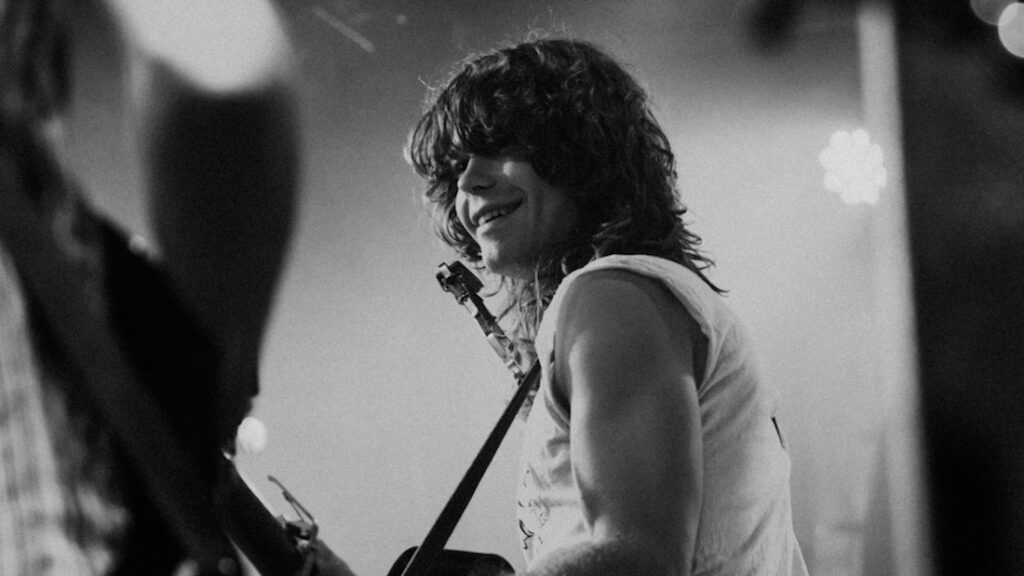
Freo.Social’s intimate space provided a fitting backdrop for Welles’s first WA show. Known to be a venue that can transform with its lineup, from high-energy rock and punk to more contemplative solo performances, Welles turned it into a sanctuary for folk-infused protest music and storytelling. The space mimicked Greenwich Village in the 1960s, especially with the hair. It must be mentioned. It was like a mop straight out of 1973—thick, shaggy, wild and falling into his eyes, and it perfectly matched his retro folk chic. The percussive strumming of his acoustic guitar gracefully held up a middle finger to the new world order establishment. Part Neil Young, part Marc Bolan, all vibes.
Momentum was building early, and there was a reserved but eager energy amongst the concertgoers. At showtime, with no dramatic entrance, no bombast, and no greeting to the audience, Welles calmly and intently walked to centre stage, alone and armed with his road-worn acoustic guitar, exuding the kind of quiet cool and confidence that doesn’t need to announce itself, and immediately launched into Join ICE, a perfectly timed opener given the current social unrest plaguing Minneapolis and the greater USA, to a huge cheer from the audience.
The opening acoustic-only stretch of approximately eight songs dutifully covered the expanse of modern culture and how he viewed his own world and the lives around him. The genius of the storytelling was the wit and humour embedded in the lyrics and how they were arranged into the deceptively simple folk tune delivery, especially on crowd favourites like Fat, Fentanyl and United Health. Other highlights included The List and The Great Caucasian God, with lines that cut into modern fractures: health, inequality, exhaustion, and the creeping absurdity of daily life.
These acoustic openers all hit with stripped-back potency, carried by a voice with a weathered edge that made every lyric feel lived-in rather than performed. The crowd responded in kind: not rowdy, nor completely vocal in recognition. Cheers rose at certain lines, as though people weren’t just enjoying the songs and the dark humour and satire infused within them, but most importantly, they agreed with what was being said.
Welles’ lyrics convey an image of a loaded pistol with the future in the chamber. A songwriter working full-throttle with a genius kind of speedwriting, who is surging through a creatively chaotic output that makes some lyrics linger and sink in like a virus. His performance invited the audience to pay attention. Songs that began gently soon sharpened into something more urgent, especially given the times. He undeniably carries the spirit of protest music in his writing, but live, it hit with a different kind of weight. The acoustic guitar was percussive, almost insistent. Although not angry in a performative way, it was more resolute. The kind of protest that comes from observation, not spectacle.
There was little small talk or banter between songs. In fact, they almost tended to seamlessly blend into one another. With a performance lasting around two hours in duration and taking in approximately thirty songs, little was said at all. However, in effect, he did not need to. He would rather let his words and music speak for themselves, and the content of his songs was all that he wanted to say. He carried with him the silhouette of shy stoicism, possibly crafted but certainly sincere in how he holds himself on stage. Not wishing to be corrupted or carried away by the corporate suits who seek to market him to the masses and cash in on his online fame. His stage demeanour suggested that he was more comfortable answering to no one but himself whilst publicly raging against the machine. The dude just wanted to jam.
And jam he did. After the acoustic set was done, without a break, his band filled the stage behind him, and things got electric. Backed by drums and bass with no additional introduction, Welles’ band hit the stage and turned up the volume. Welles himself notably changed the tone on his acoustic to fit the mould, expertly utilising some effects pedals on his acoustic (which he proudly wielded for the show’s duration) to slide into the amplified tones and up-tempo energy of the band set, rolling out Domestic Error and Philanthropist. In fact, one of the rare times that he did engage directly with the crowd was to introduce a special tour guest on his track Red, Ambrose Kenny-Smith from King Gizzard and the Lizard Wizard. Kenny-Smith unleashed a blues-psych hurricane of a harmonica jam, one of the evening’s notable highlights.
The relationship between Welles and his band was one tight unit, like they had been touring together for years. Additionally, they threw out huge crowd-pleasing covers such as Black Sabbath’s Paranoid, Nirvana’s Heart-Shaped Box and the seminal CCR classic Have You Ever Seen the Rain. Covers which were delivered as covers but still felt as if they conveyed that quintessential Welles vibe which the evening had spent cultivating. It was during this part of the show that he fully put his shredding and picking skills on display and turned up the effects and let his acoustic guitar scream out some pulsing electric tones.
Welles was left a solitary vigil on stage once more for his second acoustic piece of the night. Songs such as Bugs and Turtles and his heartfelt dedication Saint Steve Irwin allow him to detach and take a breath from protest-laden anthems and ponder the beauty of what is great in the world. Delivered like they came from the pages of his personal journal and gorgeously feel-good, there was a sense of a matured artist displaying that he wasn’t just a troubadour of doom and revelation.
With obvious comparisons and influence to arguably the greatest social commenter and protest songwriter of our time, Nobel Laureate Bob Dylan, it seemed only fitting that Welles slipped in a cover of Don’t Think Twice, It’s Alright. He may have wished to shake off the image of the comparison, although it’s undeniable the influence was there across a vast expanse of his current catalogue, along with the brooding archetype of the artist who wished not to be pigeonholed. Dropping in a rendition of Tropical Fuck Storm’s You Let My Tyres Down seemed a seminal recognition of the underground Australian music scene before he finally closed the night out with his own ballad, War Isn’t Murder.
So, in his first WA concert, which spanned nearly thirty songs across approximately two hours, with rotating acoustic and electric sets, there was a compelling mix of Welles’ protest-laden anthems and more introspective folk ballads. It was a show to be remembered and one to take notice of. Just him, his guitar, his band. No walk-offs, no speeches, no bullshit. Not controlled, not commercial, just human.
https://xpressmag.com.au/review-jesse-welles-at-freo-social/
Show Review: Freo.Social by X-Press Magazine

“We sow and sow and sow, what do we reap, yeah” — Hipster Song by Jeh Sea Wells
© Woah!
Powered with WordPress